
Quick question. If you called five different financial professionals this week and asked them the same thing — “Hey, what do you think the market’s gonna do?” — how many different answers would you get?
Five. Five completely different answers. And every single one of them would sound completely confident.
Here’s the crazy part. I don’t even need five advisors to prove it. I can prove it with one financial newsletter.
On August 16th, the headline said: “Don’t buy into the recession doom and gloom.” Great. Everything’s fine. Totally relaxed.
Three days later — same newsletter, same writer, probably sitting at the same desk — the headline said: “A storm is brewing in the stock market.”
So which is it? Is it smooth sailing, or are the wheels about to come off this thing?
Here’s the secret nobody in this industry wants to say out loud: they don’t know. They’re guessing.
And they’re not lying to you exactly. They genuinely believe what they’re writing in the moment. They just don’t actually know for sure. Some are guessing it crashes. Some are guessing the party’s just getting fired up. And both sides will give you very convincing reasons why.
That’s the problem with market predictions. They sound certain. But market predictions aren’t.
Nobody Knows. Not Even Warren Buffett.
When it comes to the stock market, nobody — and I mean nobody — knows what’s going to happen next.
You can look at past performance and economic conditions and build out reasonable scenarios. That’s real analysis. But nobody can tell you the exact day the market’s going to go up or the exact day it’s going to go down.
That’s exactly why there’s so much conflicting information out there.
And I get it. You’re probably thinking, “Well, Marty, that’s just some random newsletter. My advisor is different.”
I’m going to stop you right there. Because I have one of the best examples I’ve ever come across.
The Peter Lynch Test
If you don’t know the name, Peter Lynch ran the Fidelity Magellan Fund. He’s considered one of the greatest active stock pickers who ever lived.
Over his 12 full years running that fund, he beat the S&P 500 in 83% of those years. That is remarkable. Nobody disputes it.
But here’s the comment Dr. Wade Pfau asked in an article on his website, Retirement Researcher:
“If Peter Lynch is this generational talent, surely he could identify someone just as good as him to take over when he left.”
Lynch handpicked his successor — a guy named Morris Smith. Smith left two years later. So to make the numbers work, they combined Smith’s tenure with the next manager, Jeffrey Vinik.
Between the two of them, they ran that fund for 73 months combined. And in that time, the Magellan Fund beat the S&P 500 in 39 of those months.
That’s 53% of the time.
| Manager | Time in Charge | Beat the S&P 500 |
|---|---|---|
| Peter Lynch | 12 full years | 83% of years |
| Morris Smith + Jeffrey Vinik | 73 months | 53% of months |
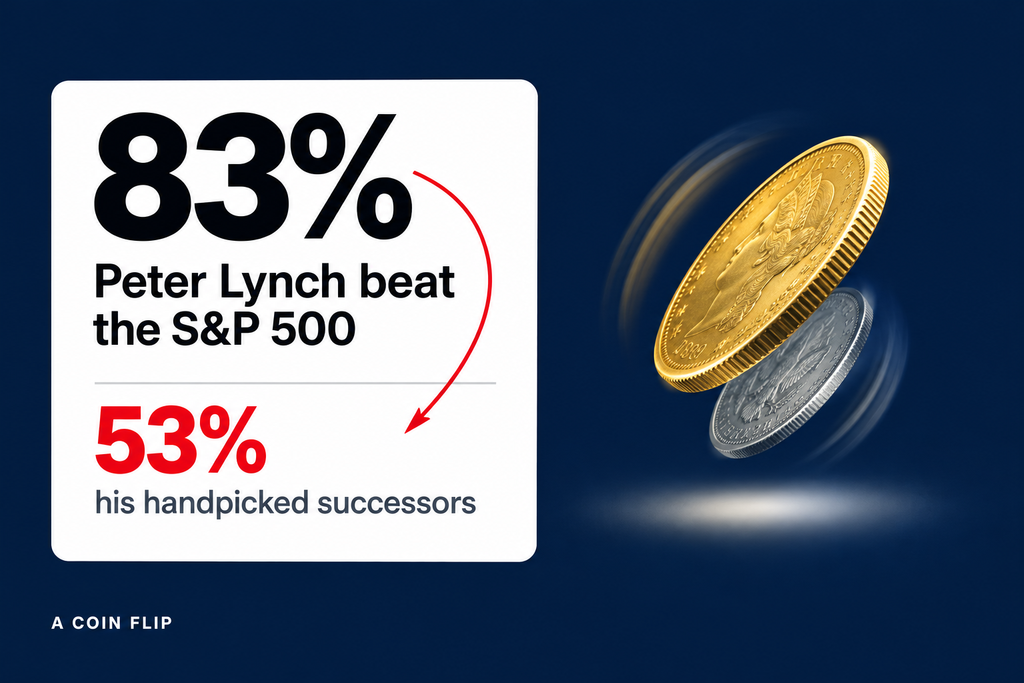
Statistically, 53% is no different than flipping a coin.
Let that sink in. The single greatest stock picker of a generation — with more access to talent and information than literally anyone else on the planet — could not identify a successor who could beat the market with any real consistency.
So when your guy, or my guy, or anybody’s guy tells you they know where the market’s headed next quarter, I want you to think about Peter Lynch and Morris Smith.
What Are You Supposed to Do With This?
I’m not telling you this to scare you or make you feel hopeless. I’m telling you because there is a way to make this entire conversation completely moot.
Here’s the solution. It’s one I walk through with clients literally every week.
Once you have enough of your income guaranteed, it really doesn’t matter what happens in the market.
Why? Because you’re not withdrawing so much money from the portfolio.
I’ll say that again, because it’s the whole point.
Once enough of your income is guaranteed, you can let the rest of your money be as aggressive or as passive as you want. You’re no longer at the mercy of the next headline.
Now, I say that very cautiously. Every individual case is going to be different. And please don’t ever buy or sell any type of securities product or insurance product without talking to a licensed advisor first.
A Real Example: Worst Case vs. Best Case
I was on a call with a potential client who did become a client. I ran the numbers and showed him two lines on a graph.
The red line was what he was currently doing — fully exposed to the market for his future income needs. He was a very high income earner. He had quite a bit of money, but he also needed a lot of money for retirement.
The green line was the Atlas annuity strategy built into his overall retirement plan. (Please watch the attached video for visuals)
Worst case market. This is a negative sequence of returns right out of the gate in retirement, using S&P 500 returns going back to the year 2000. The red line runs into some real problems. Add the guaranteed income, and everything is totally fine. Still fully funded. In fact, he still has a lot of money left.
Best case market. Everything is booming. This is going back to 1995 in the S&P 500. The red line does great, for sure. But so does the green line. Pretty much neck and neck. Zero opportunity cost for the most part.
| Scenario | Portfolio Only (Red) | With Guaranteed Income (Green) |
|---|---|---|
| Worst case (2000 returns) | Real problems | Fully funded, money left over |
| Best case (1995 returns) | Does great | Does great — neck and neck |
And once it’s set up, there’s no babysitting. No checking CNBC every morning. No texting your advisor every time the market dips 2%. It’s pretty much on autopilot.
What About the Rest of Your Money?
I’m not a securities advisor. I’m not telling you to buy, sell, or pick any certain equity fund, mutual fund, or stock. That’s not my wheelhouse. My wheelhouse is safe money.
But for the portion of your money that isn’t funding the guaranteed income — and remember, I would never recommend putting your money into any single category, and with annuities they won’t let you do that anyway — what are you supposed to do with the rest?
My suggestion: stop trying to pick winners. Stop trying to time the market.
If you want a simple, research-backed way to think about the rest of your portfolio, a really great resource is a book called The Coffeehouse Investor.
I know about this book because one of my very first annuity clients 10 years ago recommended it to me. He was a high school teacher at a private high school. He never really made a lot of money in his career. He didn’t have the public school pension.
But by following the low-cost index fund philosophy in that book, he built up almost $2 million for his retirement portfolio.
No stock picking. No newsletters. No guessing games.
And again — always speak with a licensed securities advisor before buying or selling any securities product.
What I Really Want You to Walk Away With
The people writing those conflicting headlines are not bad people. And they’re not always wrong.
They’re just guessing. Same as everyone else. Maybe educated guessing, but it’s still guessing. And that includes some of the most talented people to ever do this.
So here’s the truth about market predictions: you cannot control the market. You cannot control inflation. You cannot control how long your retirement needs to last.
But you can control how much of your income is guaranteed.
And once you do that, every single conflicting headline just becomes background noise.
Frequently Asked Questions
Why are market predictions so unreliable?
Because nobody knows what the market will do next. Analysts can study past performance and economic conditions, but no one can name the exact day the market goes up or down. That’s why the same newsletter can say “don’t buy the doom and gloom” and then “a storm is brewing” three days later.
Can a professional beat the market consistently?
Peter Lynch beat the S&P 500 in 83% of his years at the Magellan Fund. But his handpicked successors only beat it 53% of the time — a coin flip. Even the best stock picker of a generation couldn’t find someone who could repeat his results.
What should I do instead of following market predictions?
Focus on what you can control. Guarantee enough of your income so you’re not withdrawing so much from your portfolio. Then the rest of your money could be as aggressive or as passive as you want.
Does guaranteed income cost me opportunity in a good market?
In a best-case market using S&P 500 returns back to 1995, the portfolio with guaranteed income performed neck and neck with the fully invested portfolio for my client given in the example. Zero opportunity cost for the most part.
What should I do with the money that isn’t funding guaranteed income?
Stop trying to pick winners and stop trying to time the market. A simple, low-cost index fund approach — like the one in The Coffeehouse Investor — is a research-backed way to think about the rest of your portfolio. Again, always speak with a licensed securities advisor.
The Next Step
If you don’t know the answer, that’s exactly what an Income Clarity Call is for. It’s free, with no obligation. We run your numbers and see whether the Atlas Annuity Strategy is a good fit for protecting you against sequence of returns risk.
Podcast Episode 121: Why Market Predictions Are Useless (Proof in 3 Days)
Download Episode 121: Why Market Predictions Are Useless (Proof in 3 Days)
on Apple Podcast