
Many people think Retirement Risk only happens if you did not save enough money. They think if you have plenty of money, it just goes away. But that is not true. Retirement Risk does not care how much money you have. Let me show you why, using a real example.
A Real Example of Retirement Risk
Here is a real client of mine. I will not use his real name, but I will use rounded numbers so you can see how it works in real life.
| What He Had | How Much |
|---|---|
| Yearly income right now | $240,000 |
| Money in 401(k)s and IRAs | $1.6 million (all in stocks) |
| Money in a brokerage account | $850,000 (all in stocks) |
| Life insurance cash value | $380,000 |
| Real estate value | $2 million |
| Annual rental income | $90,000 |
He is 59 years old and plans to sell his real estate around age 80.
Everyone Needs a Retirement Plan
Even with a lot of money, he still needed a real plan:
-
- Go part-time at age 64
-
- Earn about $60,000 a year part-time until age 70
-
- Fully retire at age 70
-
- Keep income at $20,000 a month, adjusted for 3% inflation
This is where Retirement Risk starts to matter for everybody. It doesn’t matter how much money you have — everyone needs a plan for turning savings into a steady income.
How Retirement Risk Shows Up in the Numbers
At age 70, his Social Security check would be about $5,000 a month. We also factored in a small 1% yearly increase in rental income. Here’s what his numbers looked like at age 70:
| Income Need at Age 70 | Amount |
|---|---|
| Desired yearly income (after inflation) | $332,000+ |
| Income from Social Security and rent | $160,000 |
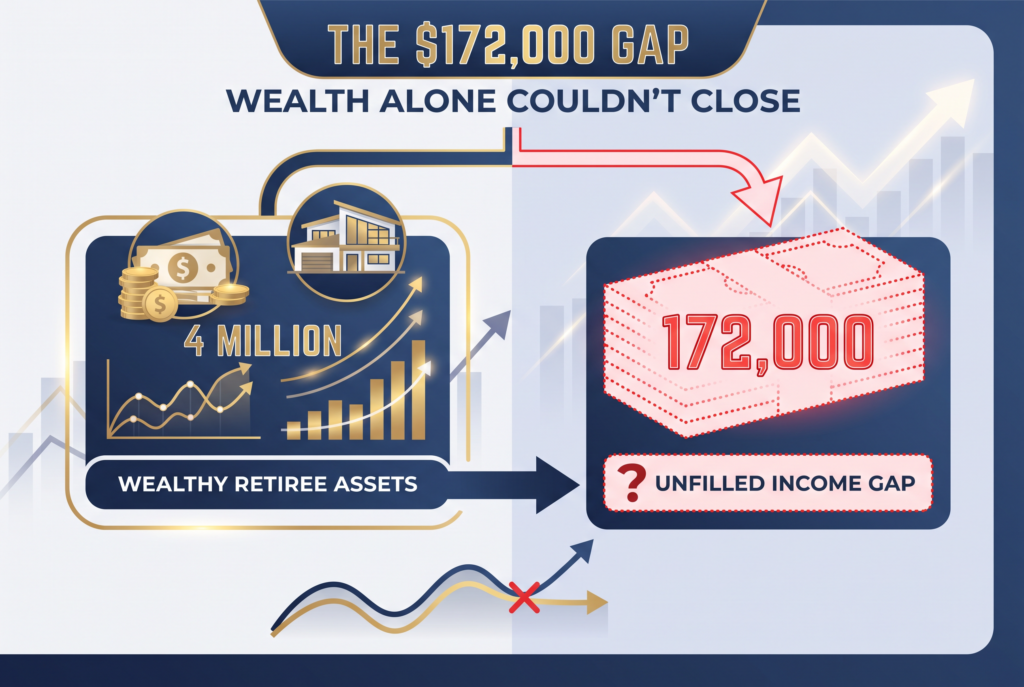
| Income Gap | $172,000 |
That $172,000 gap is a real example of Retirement Risk. It proves that no matter how much someone has saved, there can still be a hole in their monthly income. This isn’t just a rich person’s problem — it’s a math problem everyone should look at, because Retirement Risk shows up the same way once you compare income needs to guaranteed income.
The First Idea to Reduce the Retirement Risk
At first, the plan was simple: get $10,000 a month guaranteed from an annuity, add that to Social Security and rent, and pull any extra needs from other investments. This idea helped lower his Retirement Risk, but we still had to check the numbers to make sure they matched his real gap.

How the Retirement Risk Was Actually Solved
Here’s what we recommended to fully close his Retirement Risk:
-
- An annuity with an 11-year deferral period
-
- Matches his full retirement age
-
- Pays $10,000 a month starting at age 70½
-
- Premium cost: almost $685,000
That $685,000 was only a small part of his total money, but it was enough to fully close his $172,000 income gap, along with withdrawals from his investments. Solving Retirement Risk isn’t always about having more money — it’s about setting up the right kind of income.
The Real Lesson About Retirement Risk
This story isn’t really about being wealthy. It’s about a simple truth: your savings number and your income number are two very different things. Retirement Risk exists whether you have $50,000 saved or $5 million saved, because the real question is always the same — will your money create a steady, guaranteed income for the rest of your life?
If a large portfolio can still have a $172,000 income gap, it’s worth taking a real look at your own numbers. That’s the only way to know your true Retirement Risk and how to close it.
Podcast Episode 111: The Retirement Risk Even Millionaires Can’t Escape
Download Episode 111: The Retirement Risk Even Millionaires Can’t Escape on Apple Podcast