
Have you ever looked at your account statement and felt really good about the return you saw? A lot of people do. But that number might not be telling you the whole truth. And if you don’t understand the truth first, it’s almost impossible to find the right annuity for your situation.
Before we talk about the right annuity, we need to talk about a much bigger problem hiding in plain sight: the difference between an average return and an actual return.
Do You Know Your Real Return?
Here’s a question for you: Do you actually know what your real return has been over the last 10 years? Not your average return. Your actual return. Has anyone ever sat down and explained the difference to you?
Most people can’t answer that question. And that’s a big problem, because until you know your real numbers, you can’t know if you’re on the right track — and you definitely can’t know if you’re anywhere close to the right annuity for your money.
What Is an Average Return?
If you ask most advisors how the market has done, they’ll say something like, “It averages about 7% a year.”
That sounds great. If you have a million dollars growing at 7% a year, you might think that means $70,000 a year forever, with your million dollars staying fully intact.
But that’s not how it actually works.
Here’s Proof It Doesn’t Work That Way
Think about this for a second. If a million dollars really earned 7% every single year, and you only took out 4% a year, you’d end up with more money than you started with. You’d be swimming in extra cash.
So why does almost every advisor tell people to only take out 4% a year?
Because they already know something you probably don’t: average returns and actual returns are two completely different numbers.
A Simple Example Anyone Can Understand
Let’s say you start with $100,000.
-
- Year 1: Your money doubles. Now you have $200,000.
-
- Year 2: The market drops, and you lose half. Back to $100,000.
-
- Year 3: Your money doubles again. Now you have $200,000.
-
- Year 4: You lose half again. Back to $100,000.
| Year | What Happens | Balance |
|---|---|---|
| Start | — | $100,000 |
| Year 1 | Doubles | $200,000 |
| Year 2 | Loses half | $100,000 |
| Year 3 | Doubles | $200,000 |
| Year 4 | Loses half | $100,000 |
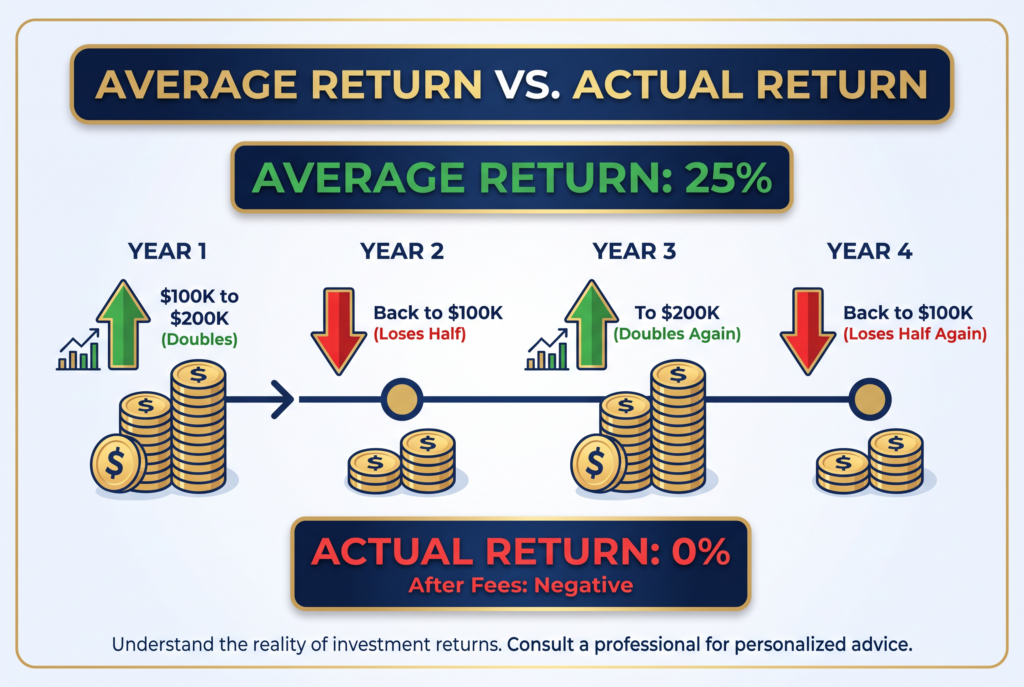
After four years, you have the exact same $100,000 you started with. But your statement will show an average return of 25%.
Your actual return? Zero.
Now add in normal fees — about 1% for management, plus another half a percent for fund fees. Once you count those, your statement still says 25% average return, but you actually end up with less money than you started with.
That gap is exactly why finding the right annuity has to start with real numbers, not average ones.
Why This Matters So Much in Retirement
Once you retire, your money moves through two phases:
-
- Accumulation Phase — You’re still working and putting money into your IRA, 401(k), or Roth.
-
- Decumulation Phase — You’ve stopped working, and now you’re taking money out to live on.
Once you move into the second phase, most advisors put you into a safer mix, like 60% stocks and 40% bonds, with a rule of taking out no more than 4% a year, plus a little more each year for rising prices.
A Real Example That Ran Out of Money
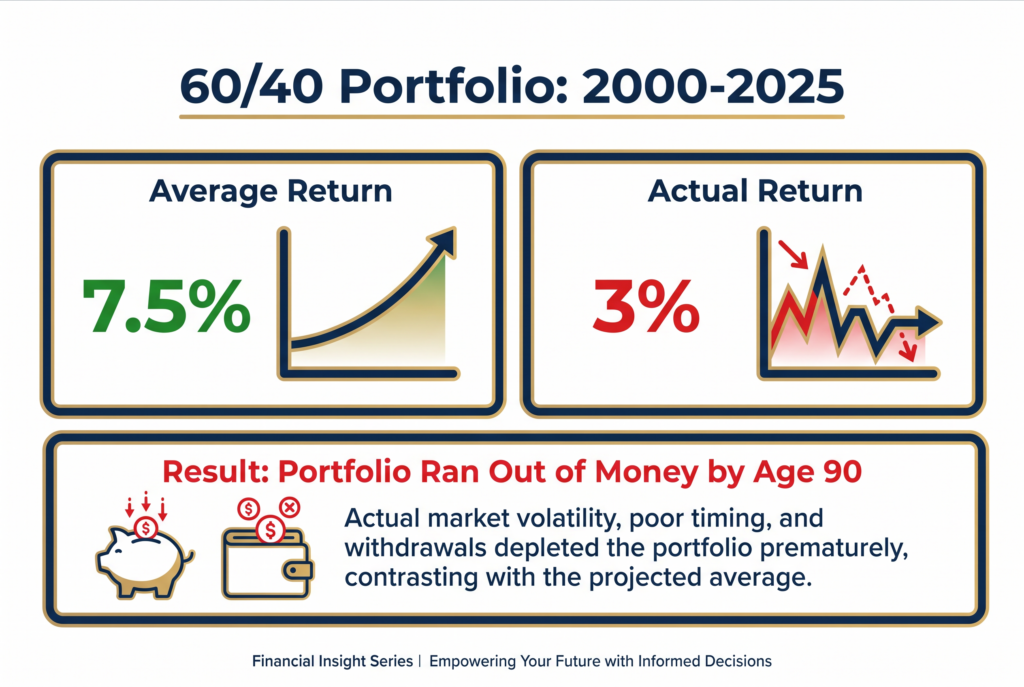
Let’s look at a real 60/40 portfolio starting in the year 2000. This is a genuine worst-case scenario that real retirees actually lived through.
-
- Average return over that time: almost 7.5%
-
- Actual return over that time: just over 3%
That gap between 7.5% and 3% is the entire reason this portfolio completely ran out of money by age 90.
If it had truly earned 7.5% every single year as the average number suggested, that retiree would have ended up with more money than they started with. Instead, the real story was much harder — and it’s exactly the kind of story that leads people to start searching for the right annuity in the first place.
So How Do You Find the Right Annuity?
If we want a fair comparison, we have to stop trusting a number that can trick us, and instead use a number that can’t. This is exactly where the right annuity comes into the picture — not as a guess, but as math.
Here’s a real example, using a married couple with $1,000,000 heading into retirement:
-
- They take $538,000 of that money and use it to guarantee $40,000 a year in income for life, no matter how long either spouse lives.
Here’s the important question: What their $538,000 need to earn every single year just to match that same $40,000 a year all the way to age 100?
The answer is 9% every single year, with no losses. Ever.
That’s not realistic for a portfolio. And here’s the truth: nothing else can guarantee that kind of income for that long. Not stocks. Not bonds. Not ETFs. Not precious metals. Not CDs.
This is exactly why finding the right annuity isn’t about chasing the biggest bonus or the flashiest number. It’s about matching guaranteed income to a real need, using real math — which is the only way to know you’ve actually found the right annuity for your situation.
What About Rising Prices (Inflation)?
Good question. In this example, the $40,000 in income from the annuity will stay level, but the rest of the portfolio can offset an additional 3% every year to help keep up with rising costs.
For the rest of the money — in this case, $462,000 — that money can stay invested. With guidance from a licensed advisor, it could even be invested a little more boldly, since guaranteed income is already covering so much of the plan.
The Results: Worst Case and Best Case
-
- Worst-case market (2000–2025 real numbers): The couple still has over $750,000 left at age 90 — even though the market crashed early in retirement. Compare that to the portfolio-only plan, which ran out completely by age 90.
-
- Best-case market (a boom like 1995): The same couple could end up with almost $2.9 million at age 90.
Same starting amount. Same income taken out every year. Very different outcomes — which shows exactly why the right annuity can change everything, in both a good market and a bad one.
Why the Right Annuity Isn’t About Guessing
Here’s what I want you to remember:
-
- There is a real, measurable difference between an average return and an actual return.
-
- Trusting the average number on your statement can quietly put your whole retirement at risk.
-
- Your actual return is the only number that tells you what your money is really doing.
-
- Finding the right annuity means figuring out exactly what your money would need to earn to match guaranteed income — a number almost nothing else can consistently deliver.
The good news is that you don’t have to give up growth to get that kind of certainty. You don’t have to hand over your entire nest egg either. The right annuity, used the right way, lets you lock in the number that matters most, and still leave plenty of room for growth with the rest.
Podcast Episode 116: Finding the Right Annuity Starts With Knowing Your Real Rate of Return
Download Episode 116: Finding the Right Annuity Starts With Knowing Your Real Rate of Return
on Apple Podcast