
Have you ever looked at an annuity and seen a chart that said “surrender schedule”? Did you think, wait… is my money stuck? A lot of people ask this question. Today, we are going to talk about surrender charges. We will look at what they are, why they exist, and why they might actually help you more than they hurt you.
What Are Surrender Charges?
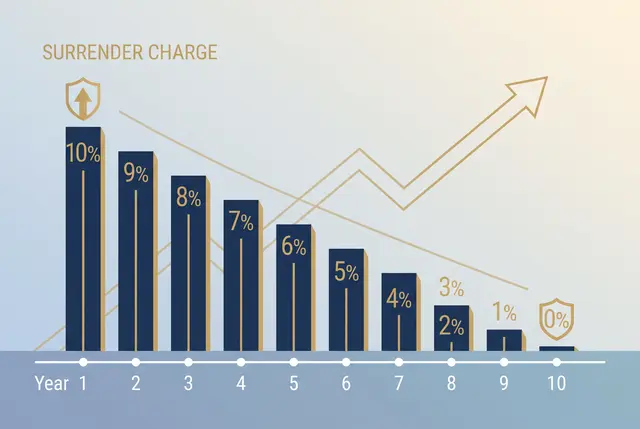
A surrender charge is a liquidity restriction. It gets smaller every year. Most of the time, it starts at 9% or 10%. Then it drops by 1% each year that goes by.
Let’s use an easy example.
Say you put $100,000 into a 10-year annuity. Six months later, you change your mind. You want all your money back right away. You would pay a 10% surrender charge. You would get back $90,000.
Now let’s say you waited. You waited until the start of year two. That is month 13. By then, most annuities let you take out 10% with no charge at all. Here is what happens:
-
- $10,000 comes back to you with zero charges (this is called your free withdrawal)
-
- The other $90,000 gets hit with a 9% surrender charge instead of 10%
-
- You walk away with $81,900 plus your $10,000 free withdrawal
Every year, the surrender charge keeps getting smaller. At the end of your term, it disappears completely. At that point, all your money is free. You can take it all out. Or you can leave it in. It is your choice.
How Are Surrender Charges Different From a Bank CD?
Here is something a lot of people do not know. Surrender charges are not that different from what banks do. If you break a CD early, you pay a penalty too. Usually, this penalty is your earned interest.
But here is the big difference. Some banks make you give up the entire CD if you break the deal early. An annuity does not work that way.
Let’s say your $100,000 annuity grew to $150,000. You need to take out $20,000. Your surrender charge has dropped to 3% by now. Here is the math:
| What Happens | Amount |
|---|---|
| Free withdrawal (10% of $150,000) | $15,000 — no charge |
| Amount left to take out | $5,000 |
| Surrender charge on that amount (3%) | $150 |
| Total reduction of accumulation value | $150 |
Your account only drops by $150. You can keep the annuity going for the rest of the term. Or even forever, if you want. You are never forced to give up the whole thing just because you needed a little more than your free withdrawal.
Why Do Surrender Charges Even Exist?
This is the part everyone wants to understand.
When you give money to an annuity company, they take that money and buy long-term bonds. These bonds are very safe. They help protect your money and build a return for you.
But these bonds have their own potential penalties too. If the company has to sell them early because you want your money back sooner than planned, they could lose money. So, they pass that same cost on to you through the surrender charge.
Think of it like a home loan. A mortgage company loans you money. They expect to get paid back over many years, maybe 10, 15, or 30 years. Now, imagine if that company could show up any day and ask for all the money back at once. You would never agree to that. It is too risky for you.
It works the same way with an annuity. Except now, it is the annuity company protecting itself from having to sell its bonds at the wrong time.
The One Thing No Other Investment Tells You
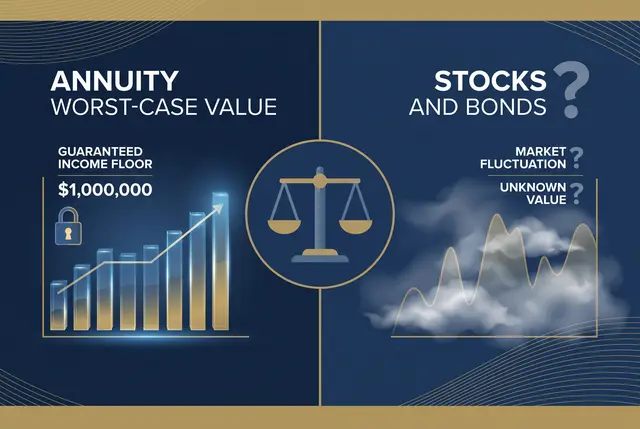
Every annuity comes with something called the MGSV. This stands for Minimum Guaranteed Surrender Value. This means that at any point, you can ask exactly what your worst possible number would be if you had to break the contract.
Compare this to other places you could put your money:
-
- Bonds do not tell you your worst-case number ahead of time. If you sell early and rates changed, you might get less than you thought.
-
- Stocks definitely do not warn you either. If your stock drops 20% and you sell, that is really a 20% penalty. Your broker just never calls it that.
An annuity, and some CDs, are really the only products that tell you your worst-case outcome before you even sign anything.
When Do Surrender Charges Become a Problem?
Here is the honest truth. A surrender charge only becomes a real problem when too much money gets put into an annuity. Money that you actually need. And that is not the annuity company’s fault. That is a planning mistake.
If someone has to pull out more than their free withdrawal amount just to pay for everyday living, that means the plan was not built the right way from the start.
This is exactly why there is an industry rule of thumb. You should never put more than about 65% of your investable money into an annuity. You should always keep plenty of money outside of it too. If someone tells you to put everything into an annuity, that is either a misunderstanding of how these products work, or it is a sales trick.
Are There Ever Exceptions to Surrender Charges?
Yes, there are some important exceptions:
-
- Terminal illness or nursing home care: Most companies will free up 100% of your money with no penalty.
-
- Death: All your money goes straight to your beneficiary with zero penalty. If your beneficiary is your spouse, they can choose to keep the annuity going or take the full amount out.
-
- Bailout provision: Some annuities let you leave with no penalty, plus your earned interest, if the company drops your rate below a certain point that they told you about when you signed up.
The Bottom Line on Surrender Charges
Surrender charges are not designed to trap you. They are a structure that lets the annuity company protect your money and give you real guarantees. At the same time, it protects the company from having to sell its own bonds at a bad time.
When your plan is built the right way, one where you never need more money than your free withdrawal allows, surrender charges never become a problem at all. Understanding how surrender charges really work, before you ever sign anything, is one of the smartest steps you can take toward a safer and more confident retirement.
Podcast Episode 117: The Good, the Bad, and the Ugly of Annuity Surrender Charges
Download Episode 117: The Good, the Bad, and the Ugly of Annuity Surrender Charges
on Apple Podcast