
If you’re looking at CDs because they feel safe, you might want to know about MYGAs. A MYGA is a Multi-Year Guaranteed Annuity. It’s basically the insurance industry’s version of a bank CD.
Let me show you how they compare.
What MYGAs and CDs Have in Common
Both of these products are very safe. Here’s what they share:
-
- No stock market risk
-
- No fees to pay
-
- Guaranteed interest rate for the full term
So far, they look pretty similar. But now let’s look at where they’re different.
The Big Differences Between MYGA vs CD
Tax Treatment
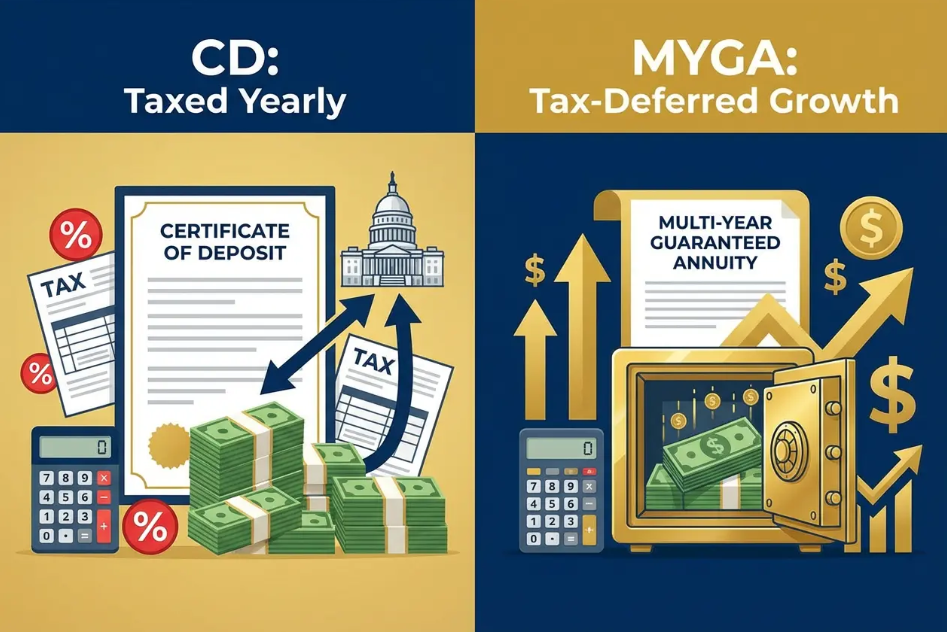
This is a big one for many people.
CDs: You get a 1099-I every year. You pay taxes on the interest even if you don’t take the money out. The only exception is if you buy the CD inside your IRA.
MYGAs: All interest is tax-deferred. You don’t pay taxes until you actually take the money out.
If you’re tax-sensitive, this matters a lot.
Getting Access to Your Money
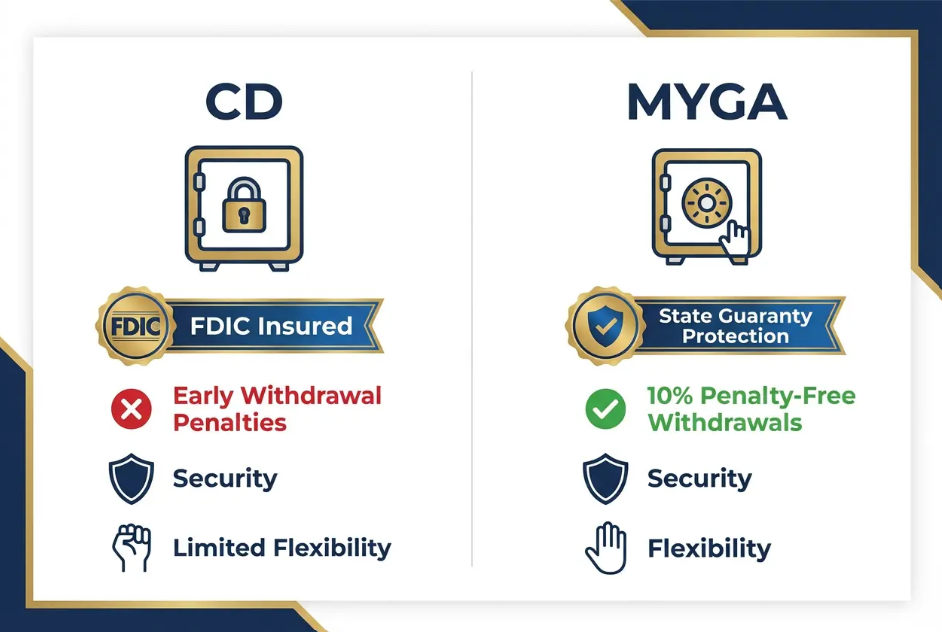
CDs: Most CDs lock up your money. You can’t touch it without a penalty. Some CDs let you take out the interest, but most do not.
MYGAs: Many MYGAs let you take the interest every year with no penalty. Some even let you take up to 10% of the total value, including your original deposit.
What Happens If You Die
CDs: The CD must go to full term. Then it gets paid out.
MYGAs: If you pass away, your beneficiaries get all the money right away. This includes all the interest that has built up.
Can You Get a Lifetime Income?
CDs: No. A CD is just a CD.
MYGAs: You can convert a MYGA into an income annuity. This can pay you for life or for a set period of time that you choose.
Taking Money Out Before Age 59½
This is tricky. A lot of people don’t know about this rule.
MYGAs: If you’re under 59½ and you take interest out, the IRS will assess a 10% penalty. This even applies to non-qualified money (money that’s not in an IRA or other tax-deferred retirement accounts).
So if you need income before age 59½, and you are using non-qualified money, you need to be aware of this.
FDIC Insurance vs State Guarantees
CDs: Your deposit is FDIC insured.
MYGAs: Your money is not FDIC insured. But you do have protection through the state guaranty system.
Disclaimer: This is not an inducement for purchase. This is for educational purposes only.
Let me explain how that works because this is important.
Quick Comparison Table
| Feature | CD | MYGA |
|---|---|---|
| Stock market risk | No | No |
| Fees | No | No |
| Guaranteed rate | Yes | Yes |
| Tax-deferred interest | Only in IRA | Yes, always |
| Penalty-free withdrawals | Usually no | Yes, up to 10% |
| Beneficiary gets money at death | No, must wait | Yes, immediately |
| Can convert to lifetime income | No | Yes |
| Withdrawals before 59½ | IRS penalty | IRS penalty |
| FDIC insured | Yes | No |
| State guarantees protection | No | Yes |
What Protects Your MYGA?
A lot of people ask me about this. They want to know what happens if the insurance company fails.
Let me give you some context first.
What Happened During the 2008 Financial Crisis
Everyone remembers 2008. That’s when Lehman Brothers and Bear Stearns failed. But let’s look at the actual numbers.
Banks:
-
- 25 US banks failed in 2008
-
- From 2008 to 2012, 465 US banks failed in total
-
- The worst year was 2010, with 157 bank failures
-
- Most were small and regional banks
Insurance Companies:
-
- About 20 to 25 life insurance companies became insolvent from 2008 to 2012
-
- There were 1,200 to 1,300 life insurers operating at the time
-
- That’s a 2% failure rate or less
-
- None were big household names
Why Insurance Companies Hold Up Better
Insurance companies are built differently from banks:
-
- They must have at least as much money as they owe (asset-liability matched)
- They don’t face “run on the bank” risk (that’s why annuities have surrender charges)
- They have stricter capital requirements than banks
- The products are contracts, not demand deposits
Even during 2008, insurance companies tightened up, but policy obligations were met.
What Were the Ratings of Failed Companies?
Here’s what we know:
-
- None of the failed insurers were rated B++ or higher
-
- None were widely used household name carriers
-
- They all had warning signs before 2008:
-
- Poor ratings (C++, B-, B)
-
- Negative outlooks
-
- Already on watch lists
-
- Long-standing money problems
-
- They all had warning signs before 2008:
What didn’t happen:
-
- No B++ or better life insurance company became insolvent
-
- No policyholders at strong carriers lost benefits
-
- The guarantee system worked in all cases
How MYGAs Are Protected
There are several layers of protection before a company would ever fail:
Layer 1: Investment Rules
Insurance companies can’t risk your money. The majority of their money is invested in investment-grade bonds.
Layer 2: Bigger Financial Backing
They have larger financial institutions backing them up.
Layer 3: State Insurance Commissioner
If things go wrong, the state insurance commissioner steps in. They try to find another company to take over all the existing policies.
Layer 4: State Guaranty Association
Each state has a life and health insurance guarantee association. These are coordinated nationally through NOLHGA (National Organization of Life and Health Insurance Guarantee Associations).
Key facts:
-
- Created by state law
-
- Funded by insurance companies, not taxpayers
-
- Only activated if a carrier becomes insolvent, and the other safety nets fail
What happens if a company becomes insolvent:
-
- The state insurance department takes control
- The guarantee association steps in
- Policies are either transferred to a stronger insurer or continued under the guarantee system
Coverage limits (typical in most states):
-
- $300,000 in life insurance death benefits
-
- $100,000 in life insurance cash value
-
- $250,000 in annuity present value benefits
For annuities, and purposes of this article, assume $250,000 for your state, but always check locally.
How to Protect More Than $250,000
I have a client who loves MYGAs. He has a lot of money in them. Here’s what we do:
-
- Put one policy in his name (up to $250,000)
- Put another policy in his wife’s name (up to $250,000)
- Once we reach the limit with each company and each spouse, we move to the next company
This is the nuclear option. As long as we use highly rated companies, this should never be an issue.
What the State Guaranty System Is NOT
Let me be clear about what this is not:
-
- It is NOT FDIC insurance
-
- It is NOT government-backed
-
- It is NOT a sales feature (don’t buy an annuity just because of this)
Make sure the annuity fits your goals first. And always pick a financially strong carrier.
For my clients, I use B++ or above. For income annuities, we go A-rated.
MYGA vs CD: Which Should You Choose?
Here’s the bottom line:
Choose a CD if:
-
- You want FDIC insurance
-
- You’re okay with paying taxes on interest every year
-
- You don’t need access to your money before the term ends
Choose a MYGA if:
-
- You want tax-deferred growth
-
- You want penalty-free access to some of your money each year
-
- You want the option to convert to lifetime income later
-
- You’re comfortable with state guarantee protection instead of the FDIC
Both are safe. Both have guaranteed rates. The question is which features matter most to you.
Next Steps
If you’ve been looking at annuities for a while and still have questions, book a call with me, and we’ll get your questions answered on a short Zoom call.
Podcast Episode 102: MYGAs vs CDs – Which Is Better for Your Safe Money?
Download Episode 102: MYGAs vs CDs – Which Is Better for Your Safe Money? on Apple Podcast